

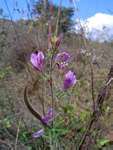
Description of the family:
Usually woody plants, i.e. shrubs, trees or climbers, less often herbs (Cleome). Stipules 0 or incompletely developed, rarely spiny (Capparis). Leaves alternate, simple or digitately 3-9-foliolate. Inflorescences terminal or axillary. Flowers actinomorphic or zygomorphic, bisexual or unisexual (by abortion), usually 4-merous, hypogynous. Receptacle cup-shaped, funnel-shaped or cylindric, sometimes very short. Sepals 3-4(-5). Petals (0-)4(5,6 or more). Stamens 2-many. In this family there is often a stalk between the sepals and the point of attachment of the stamens (androgynophore) and a further stalk between there and the ovary or fruit (gynophore). Ovary usually 1-locular. Style short or 0. Fruit a capsule or berry, variously shaped.
Comment:
The members of this family (excluding Cleome) are particularly common at lower altitudes and also on termite mounds at higher altitudes.Cleome is sometimes placed in a separate family, Cleomaceae.
Worldwide:
39 genera and 650 species, mostly warm areas with a few in arid temperate zones.
Zimbabwe:
8 genera and 42 taxa.
- Cadaba Forssk.
- Capparis L.
- Cladostemon A. Braun & Vatke
- Cleome L.
- Maerua Forssk.
- Ritchiea R.Br. ex G. Don
- Thilachium Lour