

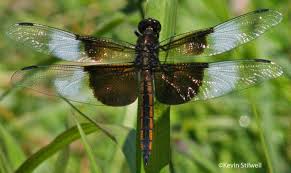
Dragonflies and damselflies both belong to the order Odonata. All odonates share certain characteristics, including membranous wings, large eyes, slender bodies, and small antennae. Conversely, there are clear differences between dragonflies and damselfies, the most obvious differences being - eyes, body, wings, and resting position
Taxonomists divide the Odonata into three suborders: Zygoptera, the damselflies; Anisoptera, the dragonflies; and Anisozygoptera, a group somewhere in between the two.
Differences between dragonflies and damselflies:
- Eyes
Dragonfly: most have eyes that touch, or nearly touch, at the top of the head
Damselfly: eyes are clearly separated, usually appearing to each side of the head - Body
Dragonfly: usually stocky
Damselfly: usually long and slender - Wing Shape
Dragonfly: dissimilar wing pairs, with hind wings broader at the base
Damselfly: all wings similar in shape - Position at Rest
Dragonfly: wings held open, horizontally or downwards
Damselfly: wings held closed, usually over abdomen - Discal Cell
Dragonfly: divided into triangles
Damselfly: undivided, quadrilateral - Male Appendages
Dragonfly: pair of superior anal appendages, single inferior appendage
Damselfly: two pairs of anal appendages - Female Appendages
Dragonfly: most have vestigial ovipositors
Damselfly: functional ovipositors - Larvae
Dragonfly: breathe through rectal tracheal gills; stocky bodies
Damselfly:breathe through caudal gills; slender bodies
Species found in Zimbabwe: