

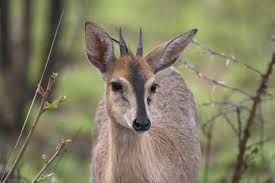
Type:
Mammal
Diet:
Leaves, flowers, fruits and tubers
Size:
Grows to about 50cm in height. The males's horns can grow to 11 cm long.
Weight:
Weighs generally 12 to 25kgs, females are generally larger and heavier than the males.
Protection Status:
Least Concern
General Backgound:
A duiker is a small to medium-sized brown in colour antelope native to Sub-Saharan Africa. Duikers are split into two groups based on their habitat: forest and bush duikers. All forest species inhabit the rainforests of Sub-Saharan Africa, while the only known bush duiker, grey common duiker occupies savannas. Duikers are very shy, elusive creatures with a fondness for dense cover; those that tend to live in more open areas, for example, are quick to disappear into thickets for protection.
Because of their rarity and interspersed population, not much is known about duikers; thus, further generalizations are widely based on the most commonly studied red forest, blue, yellow-backed and the common grey duiker. In tropical rainforest zones of Africa, people non-selectively hunt duikers for their fur, meat, and horns at highly unsustainable rates. Population trends for all species of duikers, excluding the common duiker and the smallest blue duiker, are significantly decreasing; Aders' and particularly the larger duiker species such as the Jentink's and Abbott's duikers, are now considered endangered by the IUCN Red List of Threatened Species
Places in which they are found in Zimbabwe:
Most Major National and Wildlife Parks
Chimanimani National Park
Chizarira National Park
Gonarezhou National Park
Hwange National Park
Kazuma National Park
Mana Pools National
Matusadonha National Park
Matobo National Park
Victoria Falls National Park