
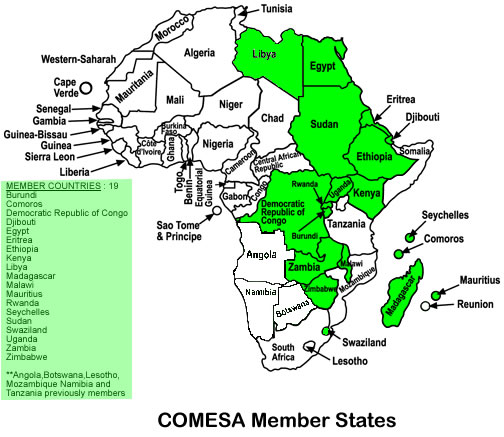
Trade between the 19-member Common Market for Eastern
and Southern Africa (Comesa) has reached $15 billion,
a mere 2,2% of the regional bloc's total GDP of over
$718 billion.Speaking at a workshop on trade
protocols, Comesa regional office representative
Tasara Muzorori said there was need to increase
production in order to boost trade in the region.
"There is a very big market for Zimbabwean products.
Member States like Egypt, Zambia, Kenya and Mauritius
are big markets and spenders."To increase trade we
need to have products. So the Comesa countries should
really increase production."
Trade between the 19-member Common Market for Eastern
and Southern Africa (Comesa) has reached $15 billion,
a mere 2,2% of the regional bloc's total GDP of over
$718 billion.
Speaking at a workshop on trade protocols, Comesa
regional office representative Tasara Muzorori said
there was need to increase production in order to
boost trade in the region.
"There is a very big market for Zimbabwean products.
Member States like Egypt, Zambia, Kenya and Mauritius
are big markets and spenders. "To increase trade we
need to have products. So the Comesa countries should
really increase production."
Muzorori said Comesa country ministers have adopted
the regional industrialisation policy which encourages
value-addition to the abundant raw materials and
ultimately increase exports.
He said, currently, Zimbabwe appears not to be taking
full advantage of the lucrative markets within the
regional bloc, although Zimtrade was trying its best
to assist local companies.
Confederation of Zimbabwe Industries (CZI) trade
development and investment chairperson Henry Nemaire
also urged industry to take advantage of existing
markets to improve Comesa intra-trade.
"So we have room of more than 97% that we have not
touched. We keep going to other places, but we should
be really eating into Comesa because there are zero
tariffs," Nemaire said.
Ministry of Industry and Commerce director for
international trade, Beatrice Mtetwa said low capacity
utilisation and liquidity challenges were affecting
industrial output and competitiveness.
She said Zimbabwe was also participating in the
African Union's project to fast-track the
establishment of a Continental Free Trade Area (CFTA)
which is aimed at Boosting Intra-Africa Trade (BIAT).
According to the COMSTAT database, Zimbabwe's total
exports stood at $3,4 billion in 2010 and rose to a
peak of $4 billion in 2013 and declined again to $3,4
billion in 2015.
On the other hand, the imports were $4,7 billion in
2010 and rose to a peak of $8,5 billion in 2011 before
declining to $6 billion in 2015.
In the period under review, Zimbabwe's exports to
Comesa were sluggish, registering $267 million in 2010
and remarkably declined to $101 million in 2015.
Zimbabwe's imports from Comesa were $271 million in
2010 and peaked at $641 million in 2012 before
declining to $436 million in 2015.
BY TARISAI MANDIZHA